Core Program

Earth Care

Stewardship of 18 acres using permaculture principles — observe before acting, work with existing systems, small and slow solutions, integrate rather than segregate.

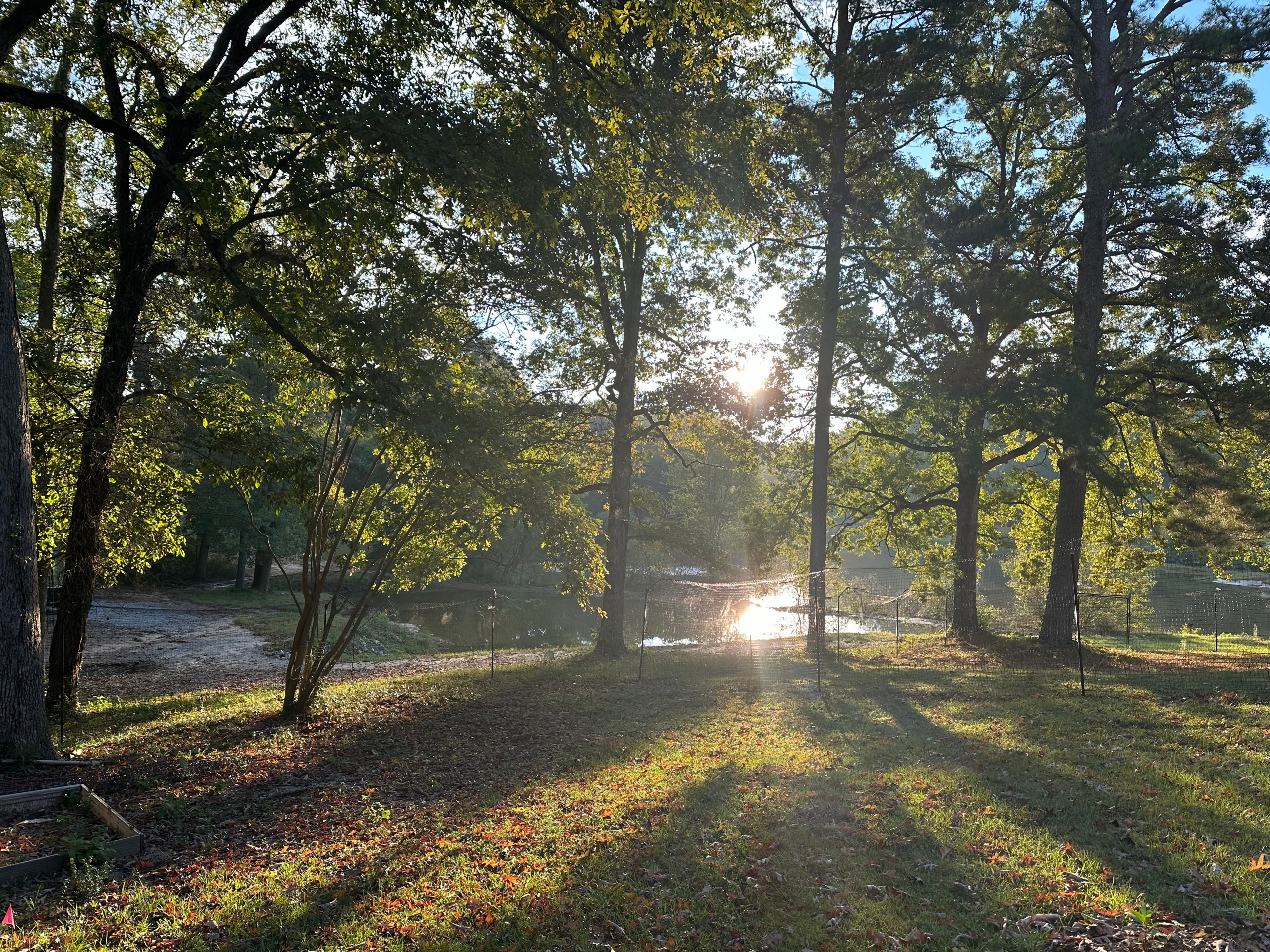
The lake at Wild Grace Sanctuary

The Land

Eighteen acres in Lithonia, Georgia. The land could sustain itself if we stopped interfering with it in unhelpful ways — that's one of the first things soil science teaches you, and it's humbling when you actually hear it. The ground knows what to do. Our job is to learn what it needs, observe it carefully, and help it rebalance from what the world has done to it.

The Earth Care side of WGS is the youngest. The land is maintained, the vision is clear, but the skills and the hands to develop it properly are still coming. That's honest, and it matters to say so. What's here right now is 18 acres that will never be a subdivision, a guardian who is studying and learning, and a commitment that this ground will be tended using principles that respect what's already alive in it.
Permaculture Framework

Permaculture gives us the framework. Those principles don't just describe how to care for land — they describe how WGS works across everything we do. The permaculture ethics are literally Earth Care, People Care, and Fair Share. That's us.

Observe

Observe Before You Act

The first permaculture principle and the foundation of everything at WGS. Watch what's here. Understand the system before you touch it. The same principle applies to animals and to people.

Work With

Work With What's Here

Don't force what you want onto the land. Respond to what's actually in front of you. Small and slow solutions. Value the margins. These are instructions for being alive.

Integrate

Integrate Rather Than Segregate

Permaculture Principle 8 — and the principle that describes WGS best. The world separated animal rescue from land stewardship from creative expression. WGS puts them back together on the same ground.

Grounding

The earth's surface carries a negative electrical charge. When bare skin contacts the ground directly, electrons transfer from the earth into the body. This is measurable physics.

Published research on earthing shows specific physiological changes from direct ground contact: reduced blood viscosity, lower cortisol levels, decreased inflammation markers, improved sleep, and changes in electrical activity in the brain.

Modern life has almost entirely severed this contact. Rubber-soled shoes, concrete, raised flooring, carpet — most people never touch the actual ground from one month to the next.

At WGS, a maintained grass area provides a dedicated space for grounding practice — bare feet on clean ground, deliberately and regularly.

Grounding area at Wild Grace

The Science

Attention restoration theory — established research — shows that natural environments replenish the specific kind of attention that modern life exhausts. Your brain has two attention systems: directed attention (effortful, finite, what you use for work and screens) and involuntary attention (effortless, what nature engages — moving water, rustling leaves, changing light). Time in nature lets the directed attention system recover while the involuntary system takes over.

Healthy soil is a living system — billions of organisms in a handful of dirt, all in relationship, all self-regulating. When you study what industrial agriculture has done to soil — compaction, chemical disruption of microbial communities, monoculture — you're looking at a precise analogy for what modern life does to humans. The soil doesn't need a new product. It needs the harmful interference to stop so its own systems can rebalance.

Permaculture's first principle — observe and interact — is a soil scientist's principle, a doctor's principle, and an improviser's principle, arrived at independently.

Current Status

Land maintained, grounding area in development, permaculture knowledge building. Full implementation requires additional expertise and hands. If you have land skills and want to be part of this, get in touch.

info@thewildgrace.org

Support the Sanctuary

Every gift sustains this space — the animals, the land, and the programs that bring them together.

Donate Now